

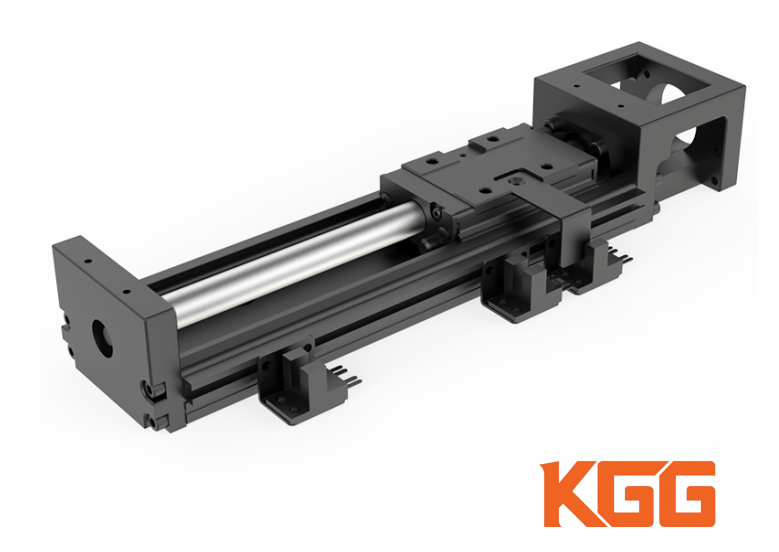
The KK series linear actuator, commonly implemented as an industrial robot axis, is an electrically driven automation component engineered for precise linear movement. Its core architecture integrates a ball screw mechanism within a U-shaped linear guide, unifying the nut and guide block into a single, compact assembly. This synergistic design merges the smooth, guided motion of the rail with the high-efficiency power transmission of the precision ball screw. The optimized U-shaped guide profile not only delivers significant space savings but also drastically reduces assembly time, consistently meeting demanding requirements for high accuracy and rigidity.
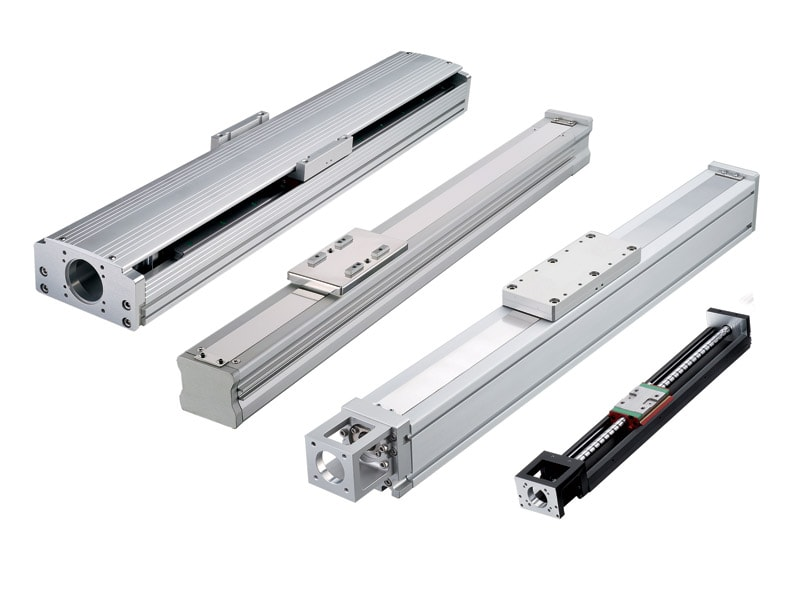
The module's rolling elements run on a raceway with a Gothic arch profile and a 45-degree contact angle. This configuration enables it to effectively manage loads from all four primary directions, making it suitable for multi-dimensional coordinated motion across X, Y, and Z axes.
I. Key Product Advantages
Streamlined Integration: A rational and thoughtful design ensures a simple and rapid installation process.
Space-Efficient & Lightweight: Its compact footprint allows for easy integration into existing machinery, reducing overall system weight and volume.
Superior Performance: High operational accuracy and exceptional rigidity guarantee consistent stability and repeatability in automated processes.
Comprehensive Offerings: We provide an extensive selection of compatible accessories and supporting components.
Adaptive Design: Engineered to fulfill a diverse range of industrial application requirements.
II. Model Selection Guide
1. Analyze Application Parameters:
Stroke: Determine the required travel distance.
Spatial Limitations: Account for length, width, and height constraints in the mounting environment.
Mounting Orientation: Supports horizontal, vertical, and side-mounted configurations.
Load Characteristics: Define the load's weight and center of gravity.
Motion Profile: Specify lead, maximum speed, acceleration/deceleration times, and duty cycle.
Operating Environment: Consider factors like temperature extremes, vibration, humidity, or corrosive conditions.
2. Define Precision Specifications:
Positioning Accuracy: The accuracy of reaching a commanded position.
Repeatability: The consistency of returning to the same position over multiple cycles.
Running Parallelism: The straightness and parallelism of the travel path.
3. Determine System Configuration:
Single-Axis: For linear motion in one direction.
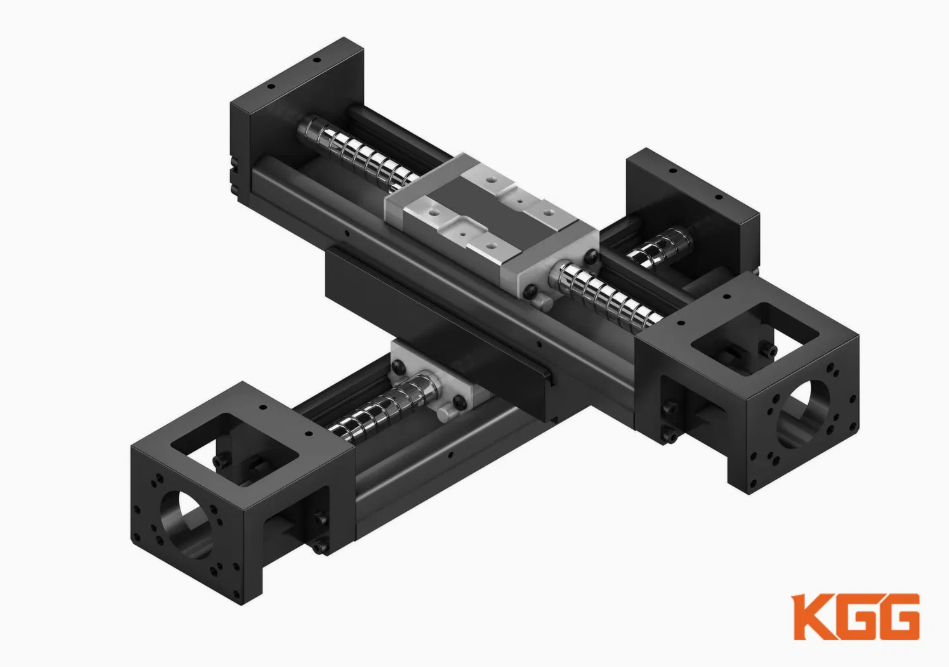
Multi-Axis: Multiple units can be synchronized and interlocked for complex planar or spatial trajectories.
Custom Builds: Modular design allows for tailored solutions to meet unique application needs.
4. Select Drive Motor:
Type: Compatible with AC servo motors or stepper motors.
Braking: Option for motors with integral or external holding brakes.
5. Size the Motor Capacity:
Speed: Ensure the motor can achieve the system's maximum required speed.
Resolution: Select motor and drive resolution to meet positioning control demands.
Torque: Verify the motor provides sufficient torque for the application's inertial and frictional loads.
6. Review Operational Dynamics:
Dynamic Response: Evaluate performance during acceleration and deceleration phases.
Motion Curve: Develop a Velocity-Time (V-T) diagram to analyze the movement profile.
7. Choose Optional Accessories:
Limit Switches: For defining travel endpoints and ensuring operational safety.
Mounting Adapters: Brackets and plates for seamless integration with machinery.
Protective Covers: Bellows-style covers and cable carriers to shield critical components from debris.
8. Finalize the Solution:
Requirement Review: Re-confirm all application conditions against the selected model's specifications.
Commercial Terms: Discuss pricing, availability, and lead times.
Customization: Inquire about special processing or custom features.
III. Typical Application Areas
Widely employed in automated inspection systems, precision dispensing machinery, PCB assembly lines, industrial robot arms, die bonders, flip-chip machines, and automated drilling centers. Furthermore, these actuators can be flexibly combined into X-Y motion platforms to suit a vast array of industrial automation scenarios.
For more detailed product information, please email us at amanda@KGG-robot.com or call us: +86 15221578410.

Written by lris.
Breaking News: The Future of Precision is Here!
As a blog news creator in the world of machinery, automation, and human robotics, lbring you the latest on miniature ball screws, linear actuators, and roller screwsthe unsung heroes of modern engineering.
Post time: Jan-05-2026


